
How to Type British Pound Symbol (£) on Laptop Keyboard — Windows and Mac Shortcuts
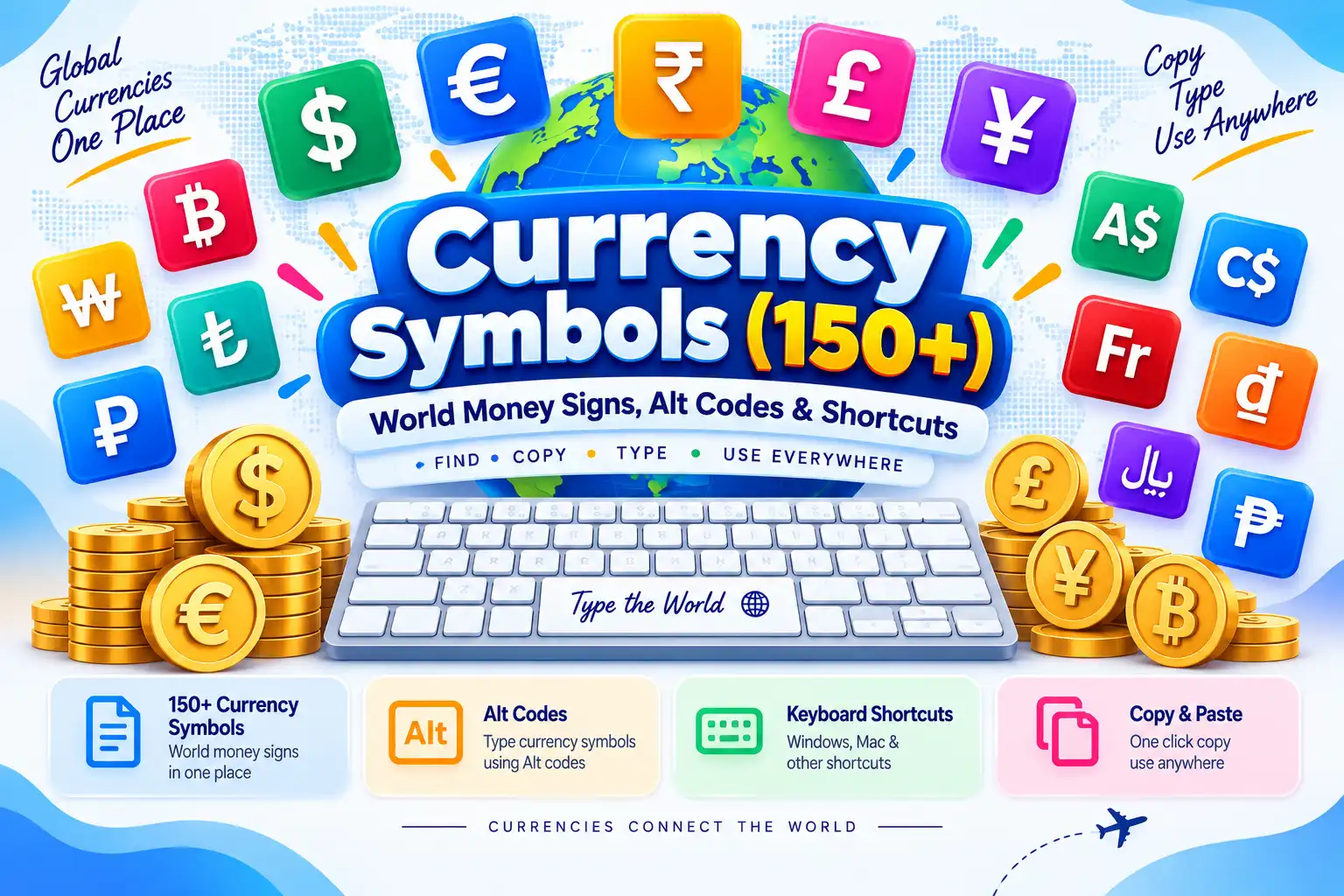
Visual Guide: Typing the British Pound (£) and world currency symbols on laptop keyboards
QUICK REFERENCE

How to Type £ in Laptop: Quick Summary & Shortcut Matrix

Wondering how to type £ in laptop keyboards when there is no dedicated physical key or numeric keypad? The Pound Sterling symbol (£) is the official currency sign of the United Kingdom, Crown Dependencies, and British Overseas Territories. Because modern compact laptops (Dell XPS, HP Spectre, Lenovo ThinkPad, ASUS ZenBook, Surface Laptop, and Apple MacBook) lack a separate 10-key numeric keypad, typing the British pound sign requires specific keyboard shortcuts or built-in system tools.

The fastest way to type £ depends on your operating system and keyboard layout:

Operating System / Program Keyboard Shortcut Conditions & Keyboard Layout Example Output
MacBook (US Keyboard) Option + 3 Standard US QWERTY MacBook layout £50.00
MacBook (UK Keyboard) Shift + 3 British English (UK) macOS layout £250
Windows Laptop (No Numpad) Win + . → Currency → £ Windows 11 & 10 Emoji & Symbol Panel £1,000
Windows Laptop (With Numpad / Fn) Alt + 0163 or Alt + 156 Hold Alt, type numbers on keypad, release £99.99
Microsoft Word (Windows) Type 00A3 then press Alt + X Word Unicode Hex Shortcut conversion £15.50
US-International Keyboard (Win) AltGr + Shift + 4 Right Alt key (AltGr) on Windows US-Intl layout £75
Chromebook (ChromeOS) Ctrl + Shift + U, then 00a3 + Enter Unicode Hex Input in ChromeOS £500
Mobile (iPhone & iPad) Long-press $ → Slide to £ iOS Virtual Keyboard Currency popup £12
Mobile (Android / Gboard) Switch to ?123 → Tap £ or long-press $ Gboard & Samsung Keyboard symbol view £80
WINDOWS LAPTOPS

How to Type £ on Windows Laptop (4 Verified Methods)

Most modern 13-inch, 14-inch, and 15-inch Windows laptops do not have a dedicated 10-key numeric keypad on the right side. Standard number row keys across the top of the keyboard do not trigger Alt codes. Here are four reliable methods to type the pound sign on any Windows laptop:

Method 1: Windows Symbol Picker (No Numpad Needed)

  • Place your cursor where you want to insert the pound sign.
  • Press Win + . (Windows Key + Period) or Win + ; to open the Windows Emoji & Symbol menu.
  • Click on the Symbols tab (the Ω icon at the top).
  • Select the Currency Symbols category (the $ icon).
  • Click on the £ symbol to insert it immediately.

Method 2: Alt Code with Fn Key or Physical Numpad

  • If your laptop has a physical numeric keypad, make sure Num Lock is ON.
  • Hold the Alt key on the left side of your keyboard.
  • Type 0 1 6 3 (or OEM code 1 5 6).
  • Release the Alt key to generate £.
  • On compact laptops with Fn numpads: Press Fn + NumLock, hold Alt, type on the letter keys marked with small blue numbers (M=0, J=1, O=6, L=3), and release.

Method 3: US-International Keyboard Layout (AltGr)

  • Add English (United States) - United States-International in Windows Settings → Time & Language → Language & Region.
  • Switch to US-International by pressing Win + Spacebar.
  • Hold the Right Alt key (also known as AltGr) and press Shift + 4 (the dollar key).
  • The £ symbol will appear immediately without touching the numeric keypad.

Method 4: Windows Character Map Utility

  • Press Win + R, type charmap, and hit Enter.
  • Check the Advanced view box at the bottom.
  • Type pound in the Search for field and click Search.
  • Click on £, click Select, then click Copy to paste it anywhere (Ctrl + V).
APPLE MACBOOK

How to Type £ on MacBook & Apple Mac (macOS)

Typing the British Pound sign on Apple laptops (MacBook Air, MacBook Pro) is remarkably seamless compared to Windows because macOS features dedicated modifier dead keys built directly into the keyboard firmware:

MacBook with US Keyboard Layout

  • Press and hold the Option (⌥) key.
  • Press the number 3 key on the top row.
  • Release both keys: Option + 3 → £.
  • Tip: Shift + 3 on a US Mac produces #, while Option + 3 produces £.

MacBook with UK / British Layout

  • Hold the Shift key.
  • Press the number 3 key: Shift + 3 → £.
  • On British Mac keyboards, the hash symbol (#) is entered with Option + 3.

Mac Character Viewer (System-Wide)

  • Press Ctrl + Cmd (⌘) + Space to launch the Character Viewer.
  • Type pound or sterling in the top search bar.
  • Double-click the £ glyph to insert it into your active document.

Automated macOS Text Replacement

  • Open System Settings → Keyboard → Text Replacements.
  • Click the + button.
  • Set Shortcut to \gbp or \pound and With to £.
  • Whenever you type \gbp and hit space, macOS will automatically replace it with £.
MICROSOFT OFFICE

How to Type £ in Microsoft Word & Outlook

Microsoft Word and Microsoft Outlook have built-in Unicode conversion shortcuts and ribbon tools that bypass the need for a numeric keypad entirely:

Method 1: Unicode Hex Shortcut (00A3 + Alt + X)

  • Type 00A3 (or simply a3) in your Word document.
  • Immediately press Alt + X.
  • Word instantly replaces the code with the £ symbol.
  • Why this works: 00A3 is the hexadecimal Unicode code point for the British Pound Sterling character.

Method 2: Word Default Key Combination

  • Press Ctrl + Alt + Shift + 4 (or Ctrl + Alt + 4 depending on regional Office configuration).
  • Alternatively, press Ctrl + Shift + U or use Word AutoCorrect: type (c) for ©, or configure AutoCorrect in File → Options → Proofing → AutoCorrect Options to replace gbp with £.

Method 3: Insert → Symbol Ribbon Menu

  • Click on the Insert tab on the Word ribbon.
  • Click Symbol on the far right → More Symbols.
  • In the Subset dropdown, choose Latin-1 Supplement or Currency Symbols.
  • Select £ and click Insert.
SPREADSHEETS & FINANCE

How to Type £ in Microsoft Excel & Google Sheets

In financial modeling, accounting, and spreadsheet data entry, there is a vital distinction between typing the raw character and formatting cell numbers as British Pounds:

Format Numbers as £ (Preserves Math Calculations)

  • Select the cells containing your numeric values.
  • Press Ctrl + 1 (Mac: Cmd + 1) to open the Format Cells dialog.
  • Under Category, choose Currency or Accounting.
  • In the Symbol dropdown, select £ English (United Kingdom).
  • Click OK. The numbers will display as £1,250.00 while remaining fully summable in formulas (=SUM(A1:A10)).

Excel Formulas: UNICHAR & TEXT Strings

  • UNICHAR formula: =UNICHAR(163) generates £ directly inside any cell.
  • CHAR formula (ANSI): =CHAR(163) outputs £ on Windows systems.
  • Concatenation string: =UNICHAR(163) & TEXT(A1, '£#,##0.00') generates a formatted pricing string like £450.00.
  • Google Sheets: Select cells → Click Format → Number → Custom currency → British Pound (£).
CHROMEBOOK & DEVELOPERS

Chromebook (ChromeOS), HTML, CSS & LaTeX Codes

For programmers, web designers, and Chromebook users, the Pound symbol is supported across all major encoding standards and markup languages:

Environment / Language Syntax / Code Description Quick Copy
Chromebook Shortcut Ctrl + Shift + U → 00a3 → Enter ChromeOS Unicode input
HTML Named Entity £ Standard HTML4/HTML5 entity
HTML Decimal Code £ HTML numeric entity
HTML Hex Code £ Hexadecimal web entity
CSS Pseudo-Element content: "\00A3"; CSS ::before or ::after pseudo-content
JavaScript / JSON "\u00A3" or "\xA3" JS Unicode string literal
Python 3 "\u00A3" or chr(163) Python Unicode string / char
LaTeX \pounds or \textsterling LaTeX math & text mode symbol
URL Encoding (Percent) %C2%A3 UTF-8 percent-encoded string for URLs
KEYBOARD COMPARISON

Why Shift + 3 Types # Instead of £ (US vs UK Keyboards)

One of the most frequent points of confusion for laptop users worldwide is why pressing Shift + 3 types a number sign / hashtag (#) on some laptops and a pound sterling sign (£) on others:

US Keyboard Layout (ANSI Standard)

On standard US keyboards (used in the US, Canada, Australia, India, and internationally):

  • Shift + 3 = # (Hash / Number sign / American "Pound" sign).
  • Shift + 4 = $ (US Dollar).
  • Shift + 2 = @ (At symbol).
  • Shift + ' = " (Double quote).
  • To type £ on US layout: Use Option + 3 on Mac, or Alt + 0163 / Win + . on Windows.

UK / British Keyboard Layout (ISO Standard)

On United Kingdom and Irish keyboard layouts:

  • Shift + 3 = £ (British Pound Sterling).
  • Shift + 4 = $ (Dollar) or AltGr + 4 = € (Euro).
  • Shift + 2 = " (Double quote).
  • Shift + ' = @ (At symbol).
  • Shift + # key = ~ (Tilde).

Etymology & History: Why Is the Pound Sign £ an 'L'?

The symbol £ is derived from the capital letter L with a horizontal bar across it. The 'L' stands for libra, the ancient Roman unit of weight (from which the modern abbreviation lbs also originates). In medieval England, a pound sterling originally represented the monetary value of one troy pound of pure silver.

FREQUENTLY ASKED QUESTIONS

Frequently Asked Questions: How to Type £ on Laptop

How do I type the £ pound sign on a laptop without a numeric keypad?

On Windows laptops without a numeric keypad, press Win + . (period) to open the symbol picker, click the Currency tab ($), and select £. In Microsoft Word, type 00A3 and press Alt + X. On a Mac laptop, simply press Option + 3.

What is the Windows Alt code for the Pound symbol (£)?

The standard Windows Alt code is Alt + 0163 (Windows-1252 character set). The legacy DOS OEM code is Alt + 156. Both must be typed on the physical numeric keypad while holding Alt.

How do you type the British Pound on an iPhone or Android phone?

On iOS (iPhone/iPad), switch to numbers (123), press and hold the dollar sign ($), and slide to choose £. On Android (Gboard), open the symbols menu (?123) and tap £ directly, or long-press $.

Does the pound sign go before or after the number?

In English typography and British financial standards, the pound sign always precedes the number without a space (e.g., £50.00, £1,000, £4.99).

What is the difference between £, ₤, and #?

£ (single bar, U+00A3) is the official modern symbol for the British Pound Sterling and Gibraltar/Falkland/Saint Helena pounds. ₤ (double bar, U+20A4) was historically used for the Italian Lira and Irish Punt. # (octothorpe / hash) is called the "pound sign" in American English when referring to units of weight (lbs) or telephone keypad buttons.